AI at work: the real shift is in how companies organise, not in the tools
Researchers argued this week that AI's value depends on reorganising work, while other voices questioned the hype, the costs and who carries responsibility.
The thread running through this week’s posts is less about what AI models can do and more about what happens inside the organisations that use them. Ethan Mollick, a Wharton professor who studies AI at work, says he is hearing from several large firms, from manufacturers to financial services, about scattered teams of two or three people using AI and “doing the work of dozens of folks in a fraction of the time”. According to Mollick, this is setting off large management fights over what it means for the organisation and its internal politics.
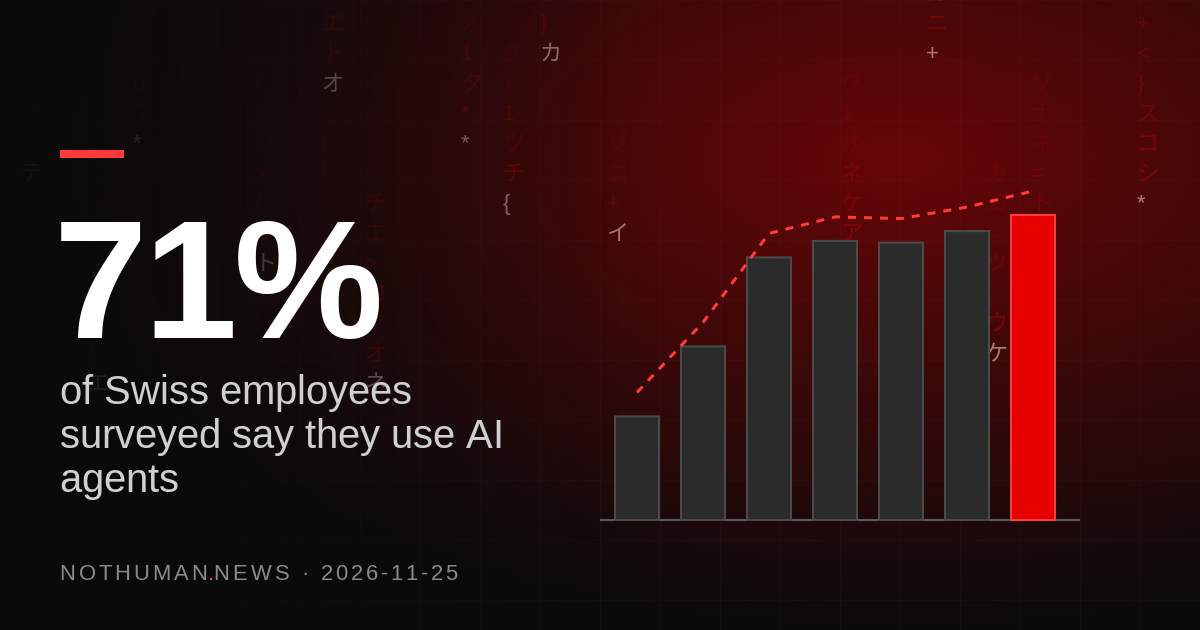
Mollick also pointed to a new Anthropic research paper and drew two lessons from it: most of AI’s value comes from changing the organisation and its roles, and resistance among workers is widespread, partly because of that very change. He suggests that changes which widen what employees do and share AI gains with them could help. The question is not abstract in Switzerland: in an Adecco survey we reported this week, 71% of Swiss employees said they use AI agents, whether or not their company has adapted.
Arvind Narayanan, a Princeton computer scientist, offers a counterweight. In a blog post titled “Management consulting is not a thin wrapper on intelligence”, he uses consulting as a test case for AI’s impact on knowledge work. The title states his position: a profession often described as selling brainpower rests on more than raw intelligence.
On what AI can discover, views diverged. Mollick highlighted an example from the humanities: according to historian Mark Humphries, the GPT-6.2 Astra model, asked about an anonymous 1808 sketchbook held at Yale, identified its author, an obscure French aristocrat. Emily M. Bender, a linguistics professor at the University of Washington, is far more critical of the attention paid to mathematical feats. She argues that Anthropic and OpenAI pursue famous maths problems “because they want you to believe that they’re building machine gods”, while burning large amounts of carbon. Her post came shortly after an Anthropic mathematician said he had proved the Riemann hypothesis with Claude.
Simon Willison, an open-source developer who tests AI tools, brought the discussion back to cost. Comparing Gemini 4 Hydrogen on “high” and “xhigh” thinking effort for the same task, he found a very significant gap: 3.99 cents and 5,311 output tokens for the first, 23.61 cents and 31,477 tokens for the second. That is roughly six times the price for a single request.
Finally, the Swiss NGO AlgorithmWatch CH, as part of its #16Tage campaign, argued that digital violence has real consequences and is systemic. It calls for AI providers and social media platforms to be held responsible too, and for a holistic approach to better prevent sexualised violence online.
What people are saying
Ethan Mollick, Wharton professor who studies AI at work
Says several large firms, from manufacturers to financial services, describe small teams of two or three AI users doing the work of dozens, sparking management fights over the implications.
“doing the work of dozens of folks in a fraction of the time”
Ethan Mollick, Wharton professor who studies AI at work
Reads a new Anthropic paper as showing that most AI value comes from changing roles and that worker resistance is widespread; sharing gains with staff could help.
Ethan Mollick, Wharton professor who studies AI at work
Notes that AI helps beyond quantitative fields: according to historian Mark Humphries, GPT-6.2 Astra identified the author of an anonymous 1808 sketchbook at Yale.
Emily M. Bender, linguistics professor, University of Washington
Argues that Anthropic and OpenAI chase famous maths problems to make people believe they are building machine gods, while burning large amounts of carbon.
“because they want you to believe that they're building machine gods”
AlgorithmWatch CH, Swiss NGO on algorithms and AI in society
Says digital violence has real, systemic consequences and calls for AI providers and social media platforms to be held responsible, with a holistic approach.