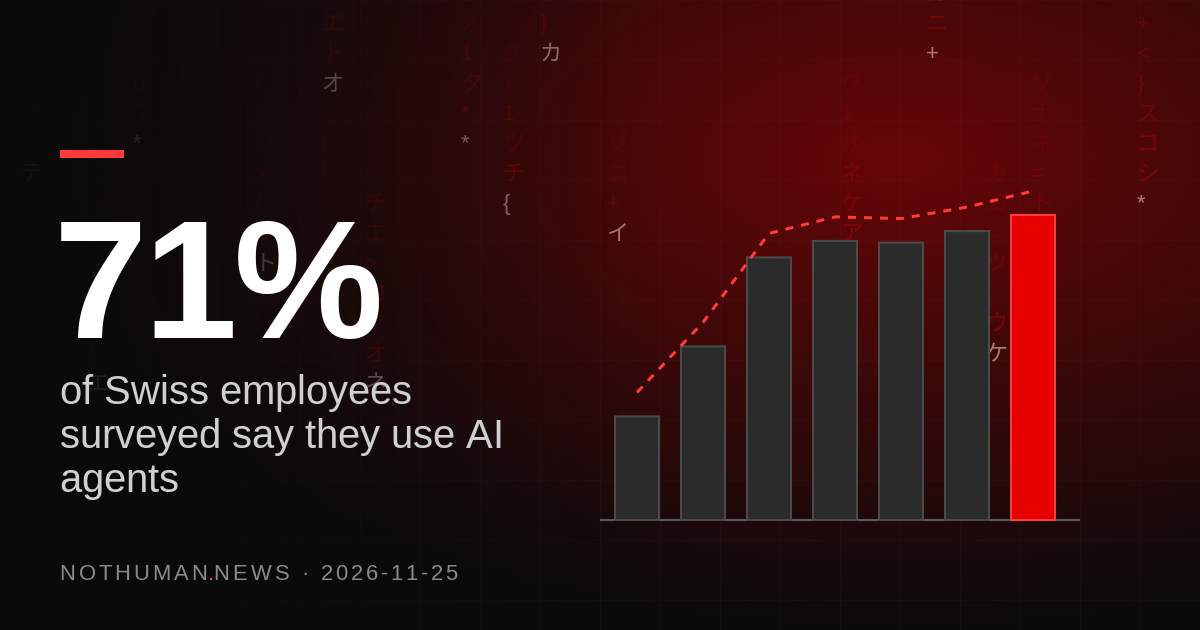
Seven in ten employees surveyed in Switzerland say they now use AI agents, meaning tools that can carry out tasks on their own, according to the Adecco Group’s “Global Workforce of the Future Report 2026”, reported by ICTjournal. A year earlier the figure was 47%. For Swiss companies, the message is less about the technology itself than about how it is introduced. The same survey suggests that integration, training and communication shape what employees get out of it.
The rise in Switzerland, 24 percentage points, is steeper than the global trend, where use went from 64% to 74%. Swiss usage therefore remains slightly below the international average, but the gap has narrowed sharply.
Respondents in Switzerland whose AI applications are well integrated into their work processes report saving on average 60% more time per working day than those with poorly integrated tools. Across all countries the gap is 20%. Among Swiss AI users who have received training, 92% say the technology gives them more opportunities to build skills or advance in their careers.
The management side looks weaker. Only 15% of Swiss respondents feel their managers show empathy for what the changes mean for staff. Where employees receive clear information on how AI is changing their work, 86% say they are comfortable with those changes. The survey also points to pressure: 36% of the highest-performing Swiss employees report that their stress level rose over the past twelve months.
For this seventh edition of the report, Adecco questioned 40,500 employees online in 36 countries and 21 sectors in June and July 2026. The Swiss sample comprised 1,022 people.
The limits matter. All results are self-reported. Time savings were not measured independently, and the data cannot show whether better integration or training actually cause the differences observed. The report as summarised also does not explain how “AI agent” was defined for respondents, so the headline figure should be read with caution.


