Almost nine in ten Swiss software companies now use AI to build software, but many have yet to put clear rules, responsibilities and success checks around it. That is the main finding of the Swiss Software Industry Survey 2026, presented by the industry association Swico on 26 October 2026. It matters well beyond the sector: these are the firms that build and maintain the software Swiss SMEs run on.
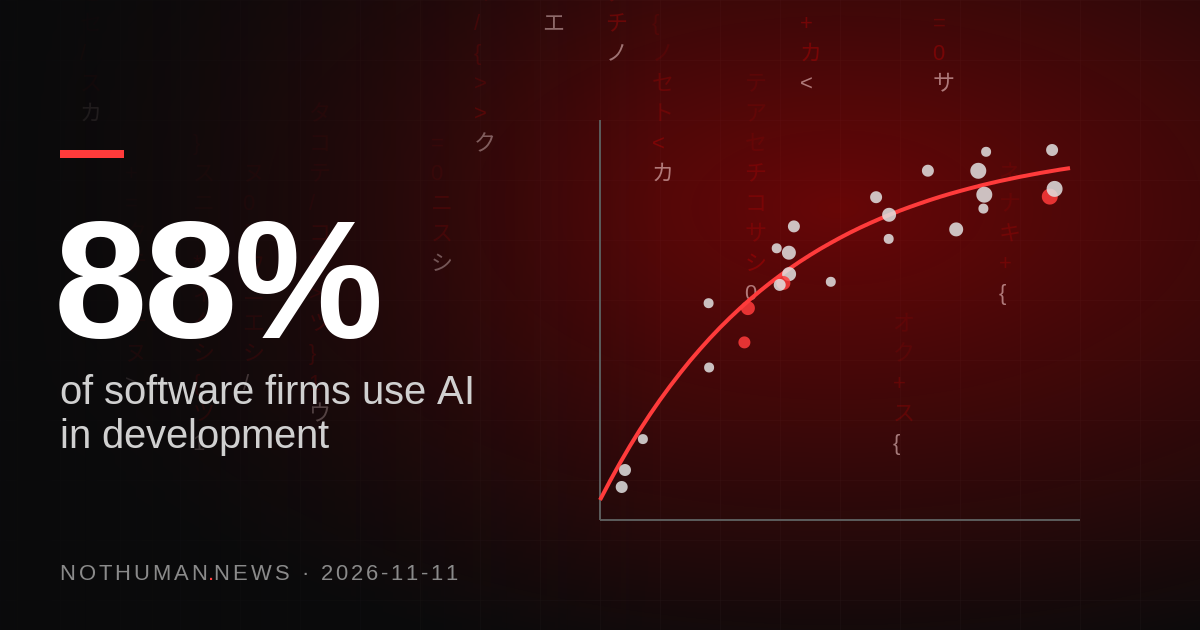
The survey, in its 12th edition, is carried out by the University of Bern’s Institute of Information Systems with sieber&partners and Swico. 115 companies took part, two thirds of them makers of standard or custom software. 88% use AI in software development, 68.5% in marketing and sales, 60.4% for management tasks and 48.7% in contract management; procurement comes last at 16%. Autonomous agents remain marginal: 82.6% of firms say they do less than 10% of the work, 62.2% at most 5%. The most common way of working is pair programming with AI; only 11.8% let several agents plan, build and test, and no firm runs a fully automated software “factory”.
Spending is climbing. Average AI investment per company was about CHF 119,000 in 2025, and respondents expect around CHF 199,000 in 2026 and CHF 234,000 in 2027. Almost half (47.6%) goes to AI platform services, licences included, ahead of in-house development (23.7%) and staff training (17%). Claude, ChatGPT and Microsoft Copilot are the tools named most often, followed by GitHub Copilot and Gemini; Mistral appears only among single mentions. The authors see this reliance on a few proprietary providers as a question of digital sovereignty.
Customers expect shorter development times and lower costs. About 70% of firms describe their AI use as selective or structured across several stages, while a fundamental redesign of processes or business models is rarer. Management often sets goals and standards, but formal processes for steering projects, training, budget control and measuring success are less established. Study lead Jens Dibbern says systematic AI governance is gaining importance.
The figures need caution. They are self-reported by roughly 100 to 115 firms depending on the question, averages can be pulled up by a few large players, and the sums for 2026 and 2027 are expectations. Nor does the survey show whether AI has yet made software cheaper for customers. The backdrop is flat: the average EBIT margin rose from 6.4% to 7.2% in 2025, but the study expects revenue to slip by 0.26% in 2026 and employment to fall slightly.