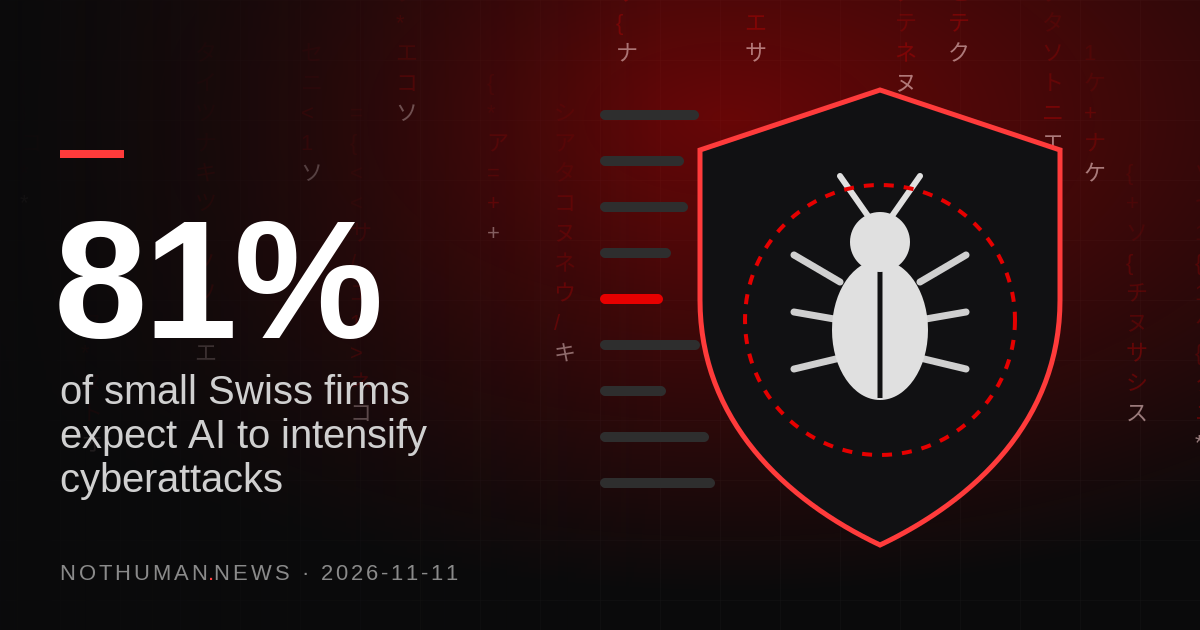
Four out of five small Swiss companies expect artificial intelligence to make cyberattacks worse, according to the study “KMU Cybersicherheit 2026”. Yet many of them have not done the organisational groundwork that limits the damage once an attack gets through.
The insurer Mobiliar carried out the study with the Federal Office for Cybersecurity (BACS), digitalswitzerland, HES-SO, HWZ and SATW; BACS published a summary on 22 October 2026. Between 24 June and 10 July 2026, 507 managers of SMEs with 1 to 49 employees were surveyed, and Mobiliar says the results are representative of about 614,400 Swiss SMEs. 81% expect AI to intensify cyberattacks, while, according to BACS, nearly half of SMEs do not yet use AI in their own projects. 6% reported a serious cyberattack in the past three years, which Mobiliar extrapolates to more than 35,000 companies. Firms with at least ten employees were affected significantly more often than smaller ones.
The technical basics are widespread: more than 80% install software updates and 90% make regular backups. The organisational side is weaker. Only 27% regularly test whether their data can be restored, 31% train staff regularly, 28% have an emergency plan and 15% carry out regular security audits. More than half (52%) rate the risk of an attack that halts operations as rather low.
The topic is gaining weight again after a dip the year before. In 2026, 46% of firms rate cybersecurity as important or very important, up from 33% in 2025, and 31% now have an internal person responsible for cyber risk, against about 22% a year earlier. Still, 36% do not treat cyber risk as a priority. Jesús Pampín, head of Mobiliar’s cyber risk competence centre, argues that cybersecurity belongs with management, not only with IT, and that insurance can cushion risks but does not replace a firm’s own responsibility.
The study has limits. It rests on managers’ own answers, not on audits of their systems. The BACS summary does not explain how AI will change attacks; the authors only expect that criminals will use it too. The figure of 35,000 is an extrapolation from a 6% share. And the AI question measures expectations: it does not show that AI-driven attacks on Swiss SMEs have already increased.