Microsoft’s AI division (MAI) presented a family of seven models on 18 November 2026. They cover programming, image editing, real-time voice, transcription, cybersecurity and decision tasks. The main argument is cost rather than raw capability. According to the company, customers’ spending on tokens is rising fast. Tokens are the units by which AI use is billed. Customers therefore want models cheap enough to keep AI agents working around the clock.
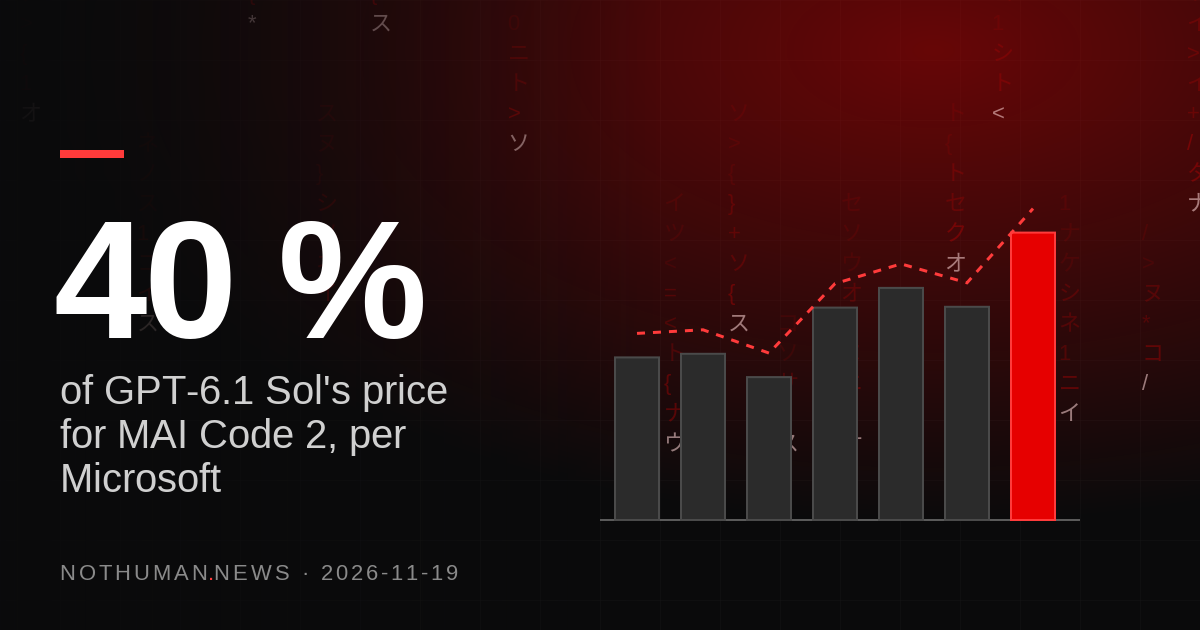
For most businesses, the coding models matter most. Microsoft says MAI Code 2 reaches 98% of the coding quality of GPT-6.1 Sol for about 40% of its price. Against Opus 5.5, it claims 96% of the performance for 5% of the price. The lighter MAI Code 2 Flash is said to perform comparably to GPT-6 Luna at 65% of the price, and to Haiku 5.5 at 20%. A security model, MAI Cyber 2 Flash, reportedly beats GPT-6 Astra on the CyberGym-E2E benchmark at under 2% of the cost per task.
On images, Microsoft says MAI Image 2.7 tops Artificial Analysis’s image-editing ranking. It reportedly beats GPT Image 2.6 Sunburst (max) at a fifth of the price. MAI Realtime 1 is built for live spoken conversations. It is priced from $0.01 per audio minute and, according to Microsoft, outperforms GPT-Realtime 2.1.
In healthcare, the Dragon Copilot Transcribe tool runs on the MAI Transcribe 2 model. Microsoft describes it as the fastest and most accurate multilingual transcription model. The company says the tool already handles 10 million patient encounters a month and has halved multilingual error rates. The seventh model, Decision 1.1, is described as 50 times faster and 79 times cheaper than GPT-6.1 Sol.
Microsoft also says Maia 200, its second-generation in-house AI chip, is now in production running its largest models. It reportedly delivers 1.7 times more tokens per watt. With these announcements, Microsoft presents itself as a model maker in its own right and competes on price against the rivals it names.
All the comparisons come from Microsoft. The announcement does not explain how the tests were run, and no independent checks are available. It also does not say through which channels or in which countries the models will be offered. Nor does it say which languages they support in practice or where data is processed. Apart from the voice model, it gives no full prices. A quality percentage on a benchmark says little about how a model performs on a company’s own tasks.