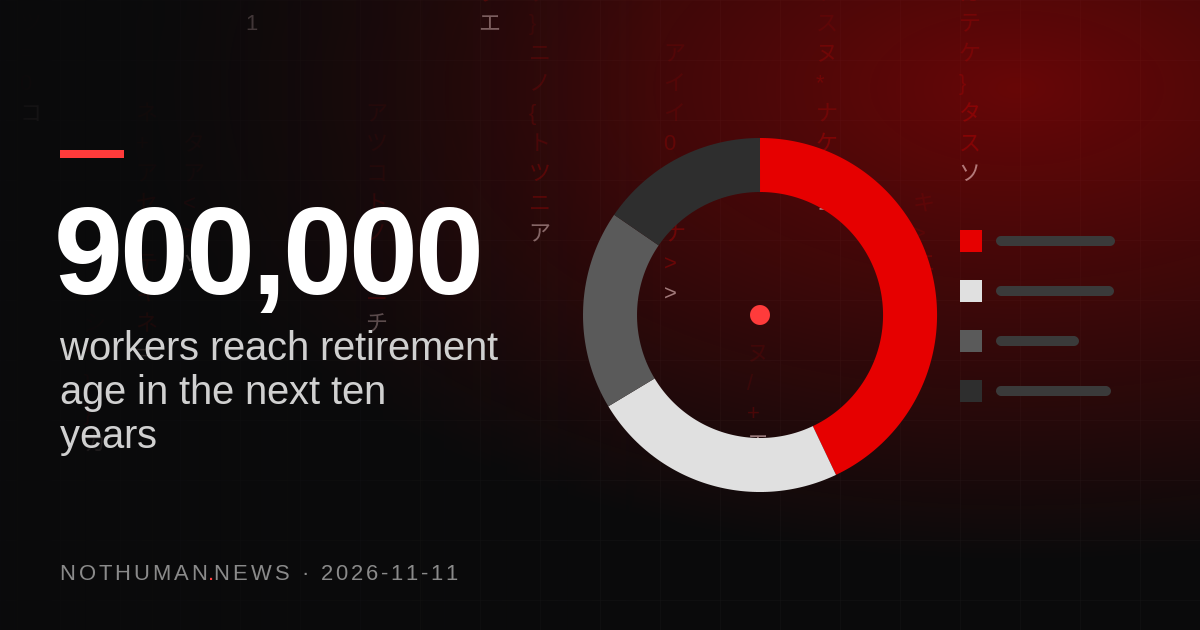
More than 900,000 people in Switzerland’s workforce, around one in five, will reach retirement age over the next ten years, and generative AI will absorb only part of that loss. That is the conclusion of an analysis of 279 occupations published by Deloitte Switzerland on 22 October 2026. It matters most for small firms in care, the trades and transport, where replacements are already hard to find.
The pressure is greatest in jobs built on people, service and hands-on work. Among qualified nurses, just under 22,000 people, or 23% of the profession, are 55 or older. The share is 30% for healthcare assistants, 33% for domestic helpers and cleaners and 35% for bus and tram drivers. In all, 109 of the 279 occupations face above-average replacement demand. In these jobs, Deloitte says, AI can help with documentation, planning, administration and looking things up, but not with caring for the sick, teaching children or physical work, so shortages are likely to persist and grow.
In software and marketing the picture is reversed: high AI potential meets low replacement demand, and Deloitte does not rule out job cuts, with entry-level roles most exposed. In programming, legal advice, translation and administration, AI increasingly handles the simple routine tasks on which beginners used to build experience. The study asks firms to plan staffing and AI together, role by role and task by task, and to rebuild early careers deliberately, for instance through apprenticeship-style learning and structured practice in reviewing AI output. Chief economist Michael Grampp warns that Switzerland must not “mistake AI for a simple solution to the demographic labour shortage” and calls for stronger vocational training.
The study is the seventh in Deloitte’s «Ageing Switzerland» series. Its AI index combines usage data from conversations with Anthropic’s Claude and Microsoft’s Copilot with exposure estimates by OpenAI researchers, mapped onto Swiss occupational data. IT and software jobs top that ranking, followed by translators, authors and journalists, then secretaries and office clerks.
Deloitte names several limits itself. AI exposure is not a forecast of job losses, the analysis is a snapshot focused on language models, and replacement demand is measured simply as the share of workers aged 55 and over, a static indicator. The usage data are international, not drawn from Swiss firms, and the study says little about small businesses, which rarely have an HR planner or time for a task-by-task review. It offers a framework, not a plan.


