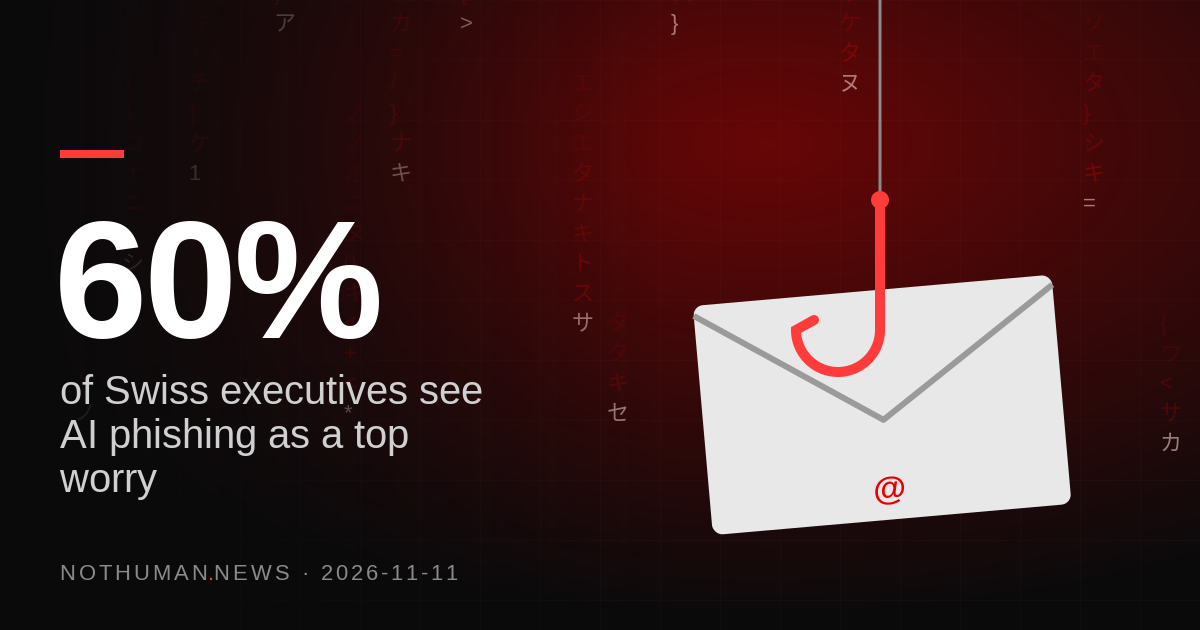
Swiss executives rank AI-made phishing as their biggest cyber worry, and Swiss employees are unusually sure they can spot it. A new Accenture survey suggests that this confidence runs ahead of training, a gap that matters to any company whose staff open e-mails.
According to Accenture’s Pulse of Change survey, as reported by Moneycab, 60% of Swiss executives call AI-generated phishing and social engineering especially relevant, against a European average of 55%, and 56% name AI-assisted malware (Europe: 51%). Cybersecurity is a high strategic priority for the next twelve months for 52% of Swiss executives, below the European 64%. Yet 41% already use AI in their security processes to detect, investigate and respond to threats (Europe: 48%). Only 31% of Swiss executives feel very well prepared for geopolitical change.
The employee figures tell a different story. 69% of Swiss staff say they are highly confident they can recognise AI-driven threats such as phishing, deepfakes and synthetic content, far above the European average of 51%. But only 49% have had formal, mandatory training on AI security risks, in line with Europe’s 48%. Of those trained, 62% say it prepared them very well or fully. AI is already part of the working day: 46% of Swiss employees use AI every day, against 37% across Europe.
Accenture surveyed 3,000 senior executives and 3,000 employees in 21 countries, Switzerland among them, in July and August 2026. Worldwide, 55% of leaders cite AI-generated phishing as a top threat. Thomas Holderegger, security lead at Accenture Switzerland, argues that resilience increasingly depends on decisions taken before an incident, and that cybersecurity belongs in a company’s AI strategy and business continuity plans.
The study has clear limits for smaller firms. It only covers organisations with annual revenue above 300 million dollars, so it says nothing directly about SMEs, and Accenture does not say how many of its respondents are Swiss. The confidence figure is self-reported: feeling able to spot a deepfake is not the same as passing a test. The survey also comes from a consultancy with its own security practice.


