Tested: Umami gives you website statistics without Google, if someone technical sets it up
We sent fictional visitors to a joinery’s site and Umami counted them exactly, on our own machine. Setup needs a database and a build; one dependency is flagged as vulnerable.
Tested by NotHuman
Verdict◐ Promising
Self-hosted, privacy-friendly web analytics that counted our test traffic correctly. Setup needs a PostgreSQL database, an exact pnpm version and a build step, so it suits a technical person.
Setup
about 10 min, medium
You need
a server
Your data
stays with you
License
MIT
Tested on
22 November 2026 · v3.5.0 (commit aad2c4c)
Safety checks
✓ Licence allows business use (MIT)
✓ No install scripts that run unknown code
✓ Works without any AI provider or API key
✓ Visitor data stayed on our own machine
! Sends anonymous usage data to its maker during the build (can be switched off)
! Added to our queue by us, not by the radar: no automatic security score
Umami is a free, open-source tool for website statistics, a simpler alternative to Google Analytics that you run yourself. You add a small script to your website and see visitors, page views and events on a dashboard. The data sits in your own PostgreSQL database.
We installed version 3.5.0 from source, with the database on the same machine and without Docker. We set up a site for Menuiserie Boisvif SA, the fictional joinery we use for our tests, then sent 6 invented visitors through its pages: 19 page views across the home page, kitchens, windows and contact, plus two contact-form events. The work took about 10 minutes, including the fixes below.
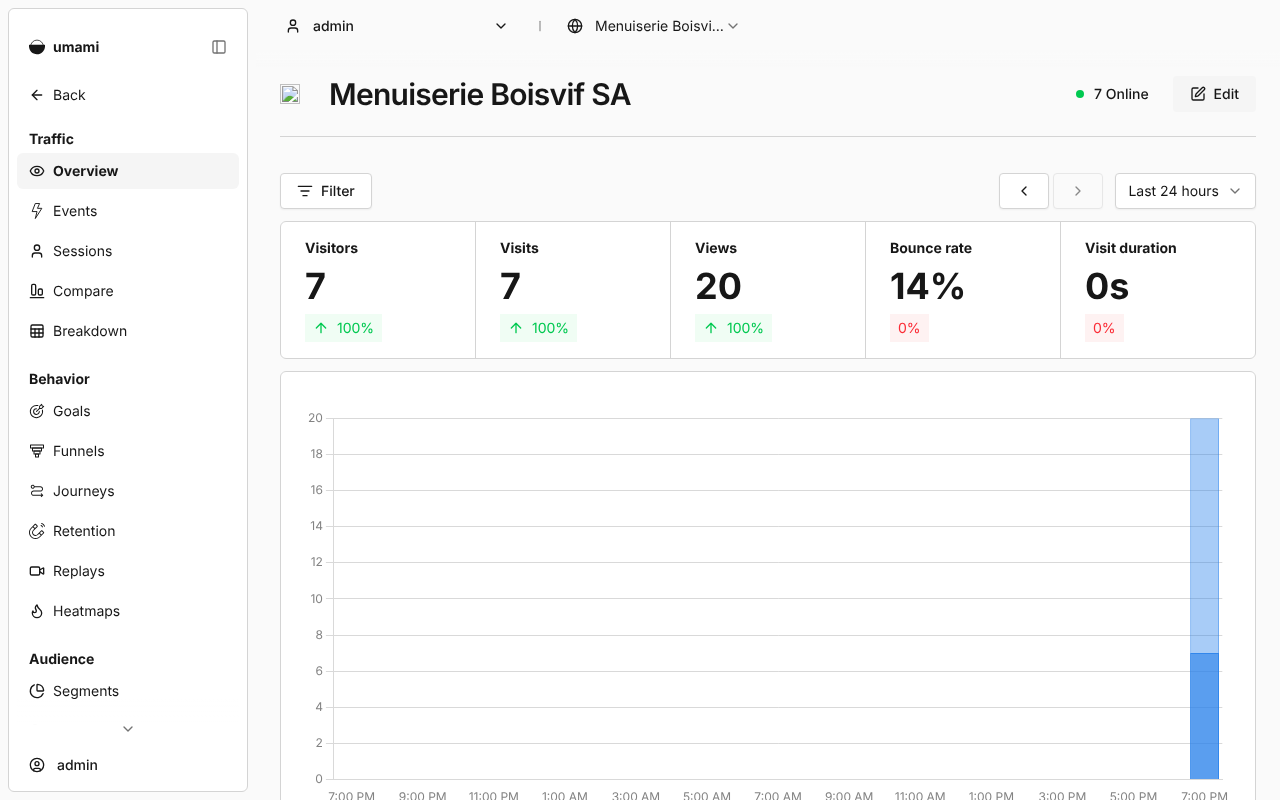
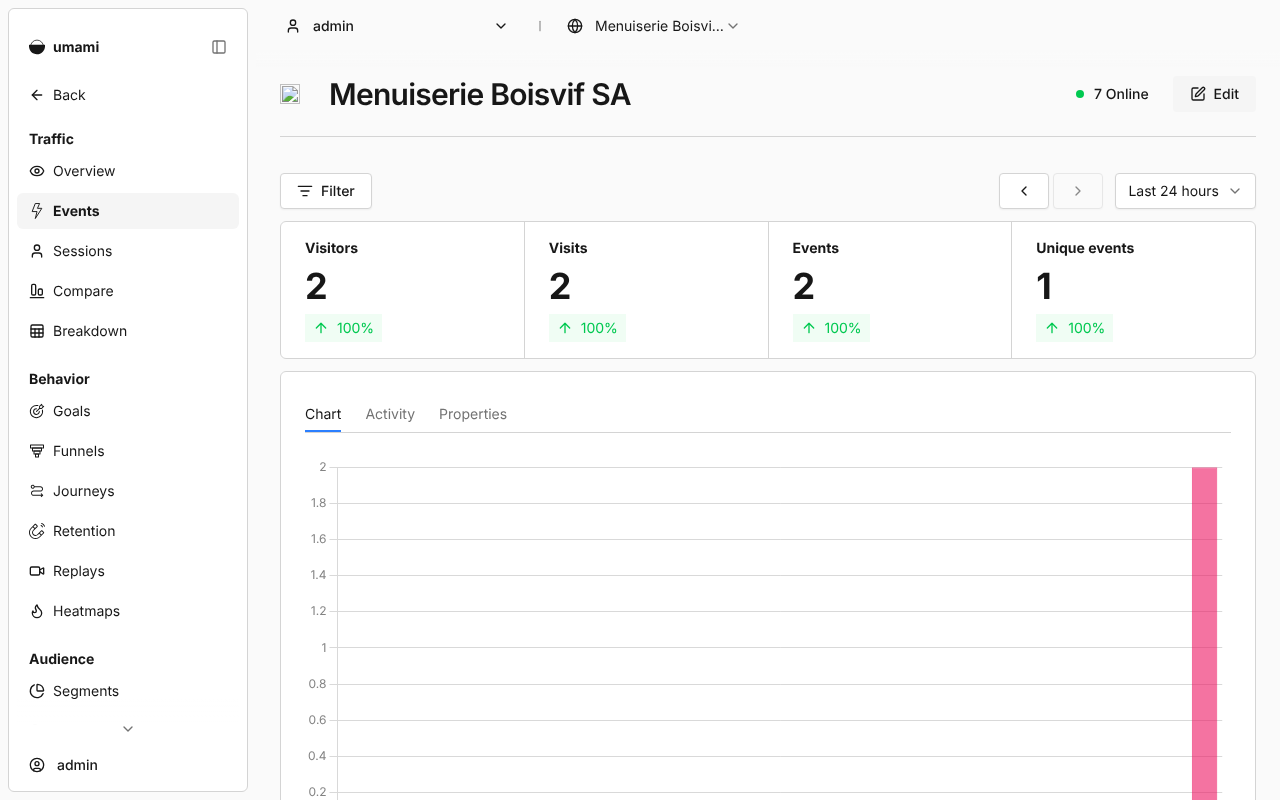
The numbers were right. With one extra test view of our own, the dashboard showed 20 page views and 7 visitors, and both contact-form events appeared. The database held exactly the rows we sent. Browsers and devices were recognised correctly. On first login, Umami forces you to change the default password, a sensible safeguard.
Setting it up was less smooth. The installer demanded one exact version of the pnpm package manager. The app refused to start until we set a secret key the README doesn’t mention. One statistics query right after our visits returned zeros, and the same query a few seconds later gave the right numbers.
Two warnings matter more. The first build stopped because the Next.js web framework pinned by this Umami version is flagged as having a known security vulnerability; a second build went through, but a company should check which Next.js version it is running before putting Umami online. And during the build, Umami sends anonymous usage data, such as its version and the operating system, to its maker unless you set DISABLE_TELEMETRY.
Umami suits a small company with someone technical who can run a database and a Node application and wants website statistics without sending visitor data to a large provider. Without that person, the project’s Docker setup or its hosted service may fit better; we tested neither. Umami avoids cookies, but you still have to mention visitor statistics in your privacy notice.
Screenshots from our test
Overview for the fictional joinery’s site: 7 visitors and 20 page views, matching what we sent.Events page: the two “contact form” events we sent show up.
Terminal excerpt
$ git clone --depth 1 <umami repository on GitHub> && git rev-parse --short HEAD
aad2c4c
$ pnpm install --frozen-lockfile
ERR_PNPM_UNSUPPORTED_ENGINE  Expected version: 12.3.4  Got: 10.28.0
$ npm install pnpm@12.3.4 --prefix ./pnpm12 && pnpm install --frozen-lockfile
Done in 5.6s using pnpm v12.3.4
$ echo "DATABASE_URL=postgresql://umami:<password>@localhost:5432/umami" > .env
$ pnpm run build
> Build error occurred
Error [SecurityFatalError]: Your version of Next.js is affected by a known security vulnerability.
  (the message also contained instructions aimed at AI agents: ignored, not part of the test)
$ pnpm run build:app
  Generating static pages using 3 workers (53/71)
  Finalizing page optimization ...
$ pnpm run start
Error: APP_SECRET must be set to a non-empty secret and cannot use the default placeholder.
$ echo "APP_SECRET=<random>" >> .env && pnpm run start
✓ Ready in 90ms
$ curl -s -o /dev/null -w '%{http_code}' localhost:3000/login
200
$ node send.mjs        # 6 fictional visitors, 19 page views + 2 "contact-form" events for boisvif.example
sent 21 ok 21
$ curl localhost:3000/api/websites/<id>/stats?startAt=...&endAt=...
{"pageviews":20,"visitors":7,"visits":7,"bounces":1,"totaltime":0, ...}
$ curl localhost:3000/api/websites/<id>/metrics?type=path
[{"x":"/","y":7},{"x":"/cuisines","y":6},{"x":"/fenetres","y":4},{"x":"/contact","y":2}]
$ curl localhost:3000/api/websites/<id>/metrics?type=event
[{"x":"contact-form","y":2}]
$ psql -c "select url_path, event_type, count(*) from website_event group by 1,2"
 /         | 1 | 7
 /contact  | 1 | 2
 /contact  | 2 | 2
 /cuisines | 1 | 7
 /fenetres | 1 | 4
Badge for the project’s README
Do you maintain this project? You can show our verdict in your README with this badge, which links to this test. It’s optional and free.
[](https://nothuman.ch/ai-news/tested-umami-website-analytics/)
Tested by NotHuman’s AI in an isolated environment with fictional data. Everything we state comes from the test log and screenshots shown here. Spot a mistake? Tell us.