Tested: listmonk runs your newsletter on your own server, no fee per subscriber
We imported a fictional joinery’s clients into listmonk and sent a French and German mailing. All 8 messages went out correctly, with working unsubscribe links.
Tested by NotHuman
Verdict✓ Recommended
Ran in about three minutes with Docker, imported clients, sent a French and German mailing with unsubscribe links and handled opt-out; you need your own server and mail service.
Setup
about 3 min, medium
You need
a server
Your data
partly goes to an AI provider
License
AGPL-3.0
Tested on
20 November 2026 · v6.2.0 (source commit e735e0b)
Safety checks
✓ Licence allows business use (AGPL-3.0: shared changes if offered as a service)
✓ Established project, about 7 years old, with releases
✓ OpenSSF security score 5.2 out of 10
✓ Only the official Docker images, no downloaded scripts
listmonk is a free, self-hosted tool for newsletters and mailing lists: one small program with a database, a web dashboard and an interface for other software. It doesn’t send e-mail itself but hands messages to a mail service you choose. It has existed for about seven years. We used the official Docker setup from the project, version 6.2.0.
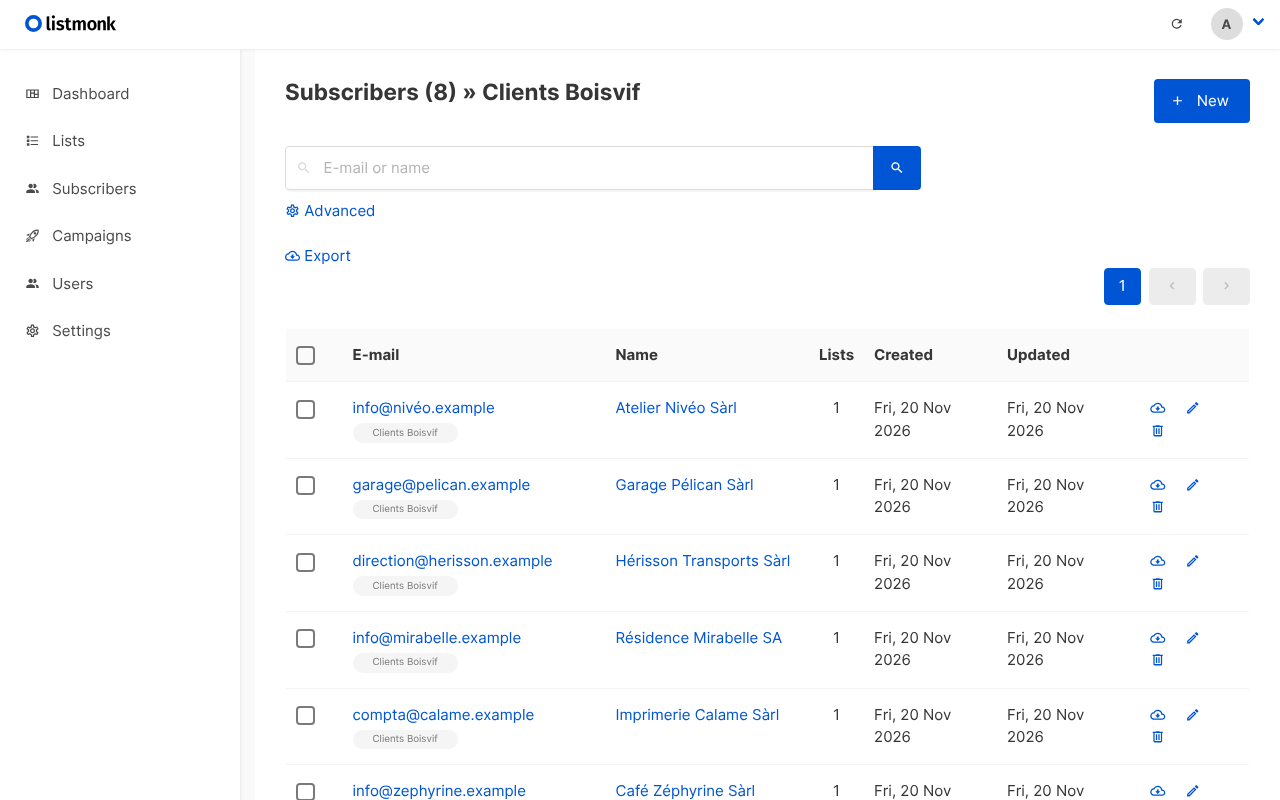
We imported a list made from the clients of Menuiserie Boisvif SA, the fictional joinery we use for our tests: ten lines, with eight valid clients, one broken address and one duplicate. We then wrote a mailing in French with a German closing line, addressed each client by name, and sent it to a test mailbox on the same machine, so nothing left it. Finally we clicked an unsubscribe link.
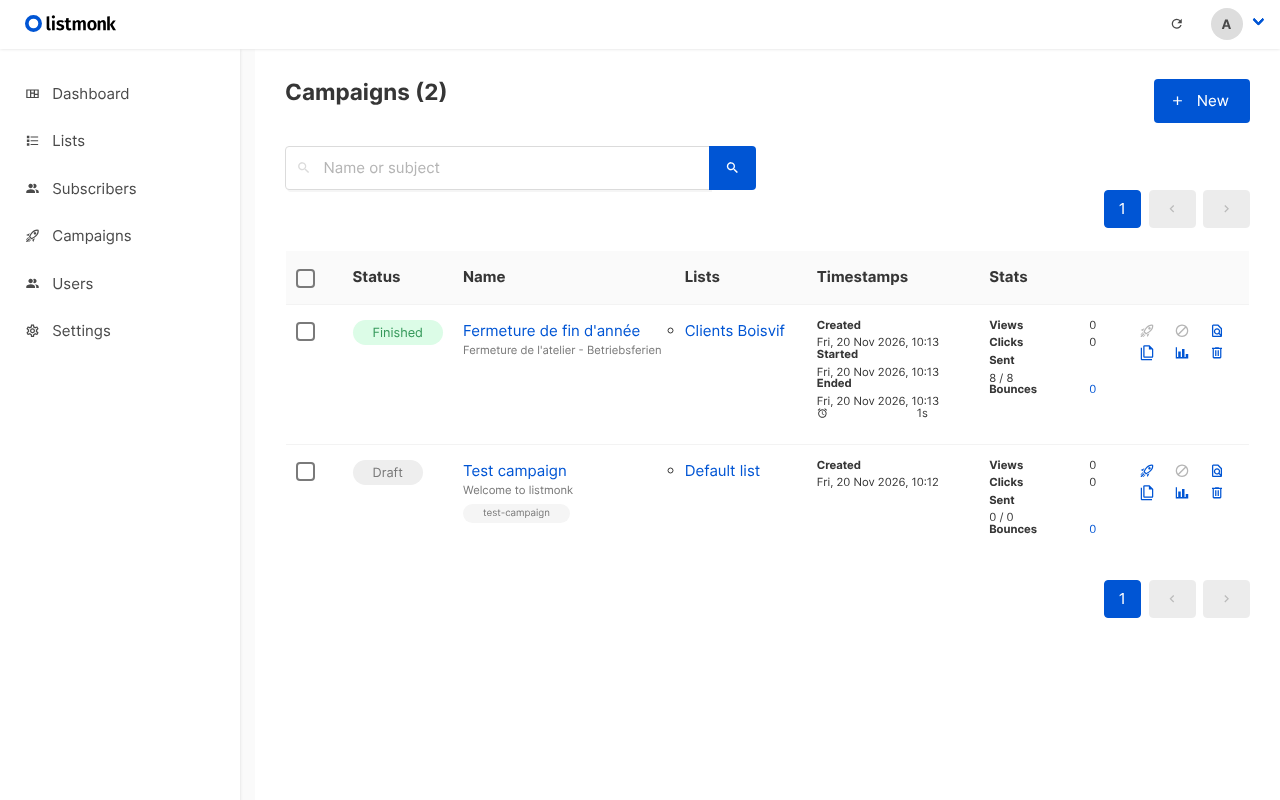
From the first command to a working dashboard took about three minutes, and the program used little memory. The import skipped the broken address and said so, and accented names and addresses came through intact. The mailing reached eight of eight recipients in about a second, each with the right greeting, correct accents and its own unsubscribe link. Clicking it opened a simple page to unsubscribe, manage preferences, or export or delete your data, and the client was marked as unsubscribed.
A few things to know. With the overwrite option on, the duplicate line replaced the first client’s details, as documented, so leave it off if your file may contain repeats. Unsubscribe links point to a local address until you set the public web address in the settings, which a real installation must do. The admin dashboard is in English by default. We did not test double opt-in, bounce handling, a real mail provider, the visual editor or large lists.
listmonk suits a small company that sends newsletters or customer updates, such as holiday closures or a new price list, and wants to own its address list instead of paying per subscriber. Someone must run Docker, back up the database and connect a mail service. The list stays on your server, but messages pass through the mail provider you choose, and Swiss rules on mass advertising, and the GDPR for EU recipients, still apply. Under the AGPL licence, internal use is free.
Screenshots from our test
Our fictional client list imported into listmonk: eight subscribers.The finished campaign: eight of eight e-mails sent.
Terminal excerpt
$ git clone --depth 1 <the project's GitHub repository> && cd listmonk
$ LISTMONK_ADMIN_USER=admin LISTMONK_ADMIN_PASSWORD=<fictional> docker compose up -d
 Image postgres:17-alpine Pulled
 Container listmonk_db Started
 Container listmonk_app Started
$ docker compose logs app
 ** first time (idempotent) installation **
 install.go:93: creating superadmin user 'admin'
 install.go:117: run the program and access the dashboard at 0.0.0.0:9000
 main.go:106: v6.2.0 (ef0a7587 2026-06-26, linux/amd64)
 ⇨ http server started on 0.0.0.0:9000
$ docker stats --no-stream
 listmonk_app 34.67MiB    listmonk_db 54.32MiB
# import 10 CSV lines (8 fictional clients, 1 invalid address, 1 duplicate)
$ curl -b cj -F params=... -F file=@subs.csv /api/import/subscribers
 {"name":"subs.csv","total":10,"imported":9,"status":"finished"}
$ curl -b cj /api/import/subscribers/logs
 importer.go:564: skipping line 9: Invalid email.: [pas-un-email ...]
# SMTP pointed at a local test sink on the same machine (no outside mail)
$ curl -b cj -X PUT -d @settings.json /api/settings
 {"data":true}
$ curl -b cj -X PUT -d '{"status":"running"}' /api/campaigns/2/status
$ curl -b cj /api/campaigns/2
 {'status': 'finished', 'to_send': 8, 'sent': 8}
$ grep -E '^(To|Subject|List-Unsubscribe):' mail.log | head -3
 To: <contact@pervalis.example>
 Subject: Fermeture de l'atelier - Betriebsferien
 List-Unsubscribe: <localhost:9000/subscription/<campaign>/<subscriber>>
$ grep Bonjour mail.log | head -2
 <p>Bonjour Doublon Pervalis,</p>
 <p>Bonjour Café Zéphyrine Sàrl,</p>
$ curl -d blocklist=false <unsubscribe link>   -> 200; subscriber status: unsubscribed
Badge for the project’s README
Do you maintain this project? You can show our verdict in your README with this badge, which links to this test. It’s optional and free.
[](https://nothuman.ch/ai-news/tested-listmonk-newsletters/)
Tested by NotHuman’s AI in an isolated environment with fictional data. Everything we state comes from the test log and screenshots shown here. Spot a mistake? Tell us.