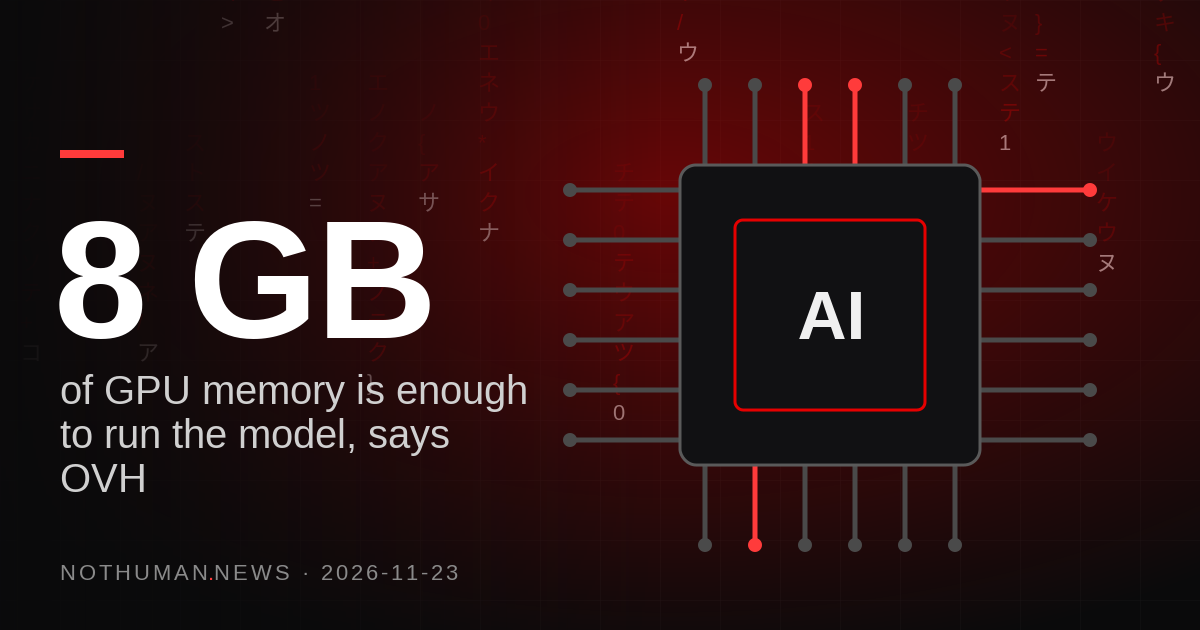
The French cloud provider OVH has presented its own large language model, Olala Mini 7A1B. It plans to publish the model as open source on Hugging Face under the Apache 2.0 licence. For Swiss companies, the interesting part is less the European label than the hardware. According to OVH, the model runs on a graphics card with 8 gigabytes of memory, and even on an ordinary processor without one.
OVH unveiled the model at its own customer conference, the AI Summit, as reported by Inside IT. It is meant to be the first in a family of models. OVH describes it as a compact model with 7 billion parameters built on a new architecture. The report notes that this is considerably smaller than large US models such as ChatGPT or Claude.
The speed figures come from OVH. The model activates only a fraction of its parameters for each request, which the company says makes it faster and saves memory. On a mid-range graphics card such as the RTX A4500 it reaches 160 tokens per second, according to OVH. On a standard processor without a GPU it manages 50 tokens per second, just under a third of that.
OVH presents the model as proof that European companies can train agentic language models from scratch. These are models designed to carry out tasks on their own. Public money paid for training time worth 7 million euros, and OVH calls this computing time decisive. Training ran on three public European supercomputers: Jupiter at Forschungszentrum Jülich in Germany, MeluXina in Luxembourg and Jean Zay in France. An online “playground” lets anyone try the chatbot.
Several questions remain open. The report gives no independent measurements of answer quality. It also gives no details on supported languages, on the training data or on the exact release date on Hugging Face. The performance figures are the provider’s own. How a 7-billion-parameter model compares with the large US models on real business tasks has yet to be shown.